Running a construction business often means carrying more responsibility than most people realise.
You are quoting work, scheduling jobs, tracking progress, answering payroll questions, and following up with clients. When systems are not clearly defined, every small decision and problem eventually lands back on the owner.
This is not a failure of effort or leadership. It is a natural outcome of a business that relies on people rather than processes.
Systemisation is how construction businesses reduce that pressure without losing control.
What Is Systemisation in a Construction Business?
Systemisation in a construction business means creating clear, repeatable processes for how work is done, from job setup and scheduling to time tracking, invoicing, and reporting.
Instead of relying on memory or individual experience, systemisation ensures the business runs consistently using shared systems that anyone on the team can follow.
It is not about adding layers of software or bureaucracy. It is about creating simple, repeatable ways of working so the business can operate consistently, even when you are not personally involved in every decision.
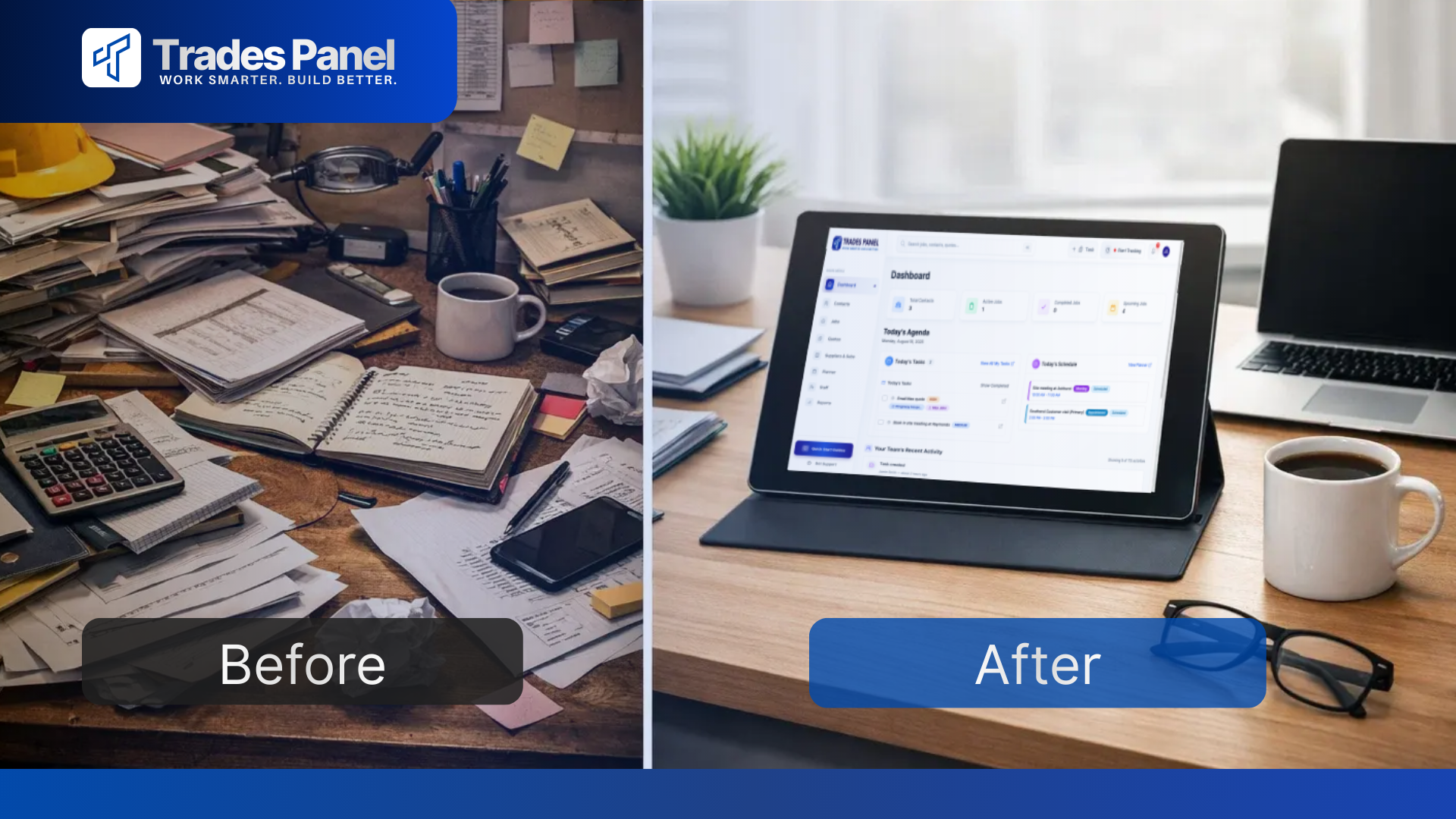
What Life Looks Like Before vs. After Systemisation
Before systemisation, most construction businesses rely heavily on memory, manual processes, and the experience of a few key people.
This approach works at first, but as the business grows, cracks begin to appear.
Common symptoms include:
Repeating the same mistakes across jobs
Work being done differently depending on who is involved
Delays in invoicing, reporting, or job close‑out
A constant feeling of needing to stay available and switched on
Over time, this creates frustration for owners, teams, and clients alike.
Construction Businesses Before vs After Systemisation
Before systemisation:
Jobs are run differently depending on who is involved
Key information lives in emails, notebooks, or one person’s head
Invoicing and reporting are often delayed
Owners feel the need to stay constantly available
After systemisation:
Jobs follow the same structure every time
Information is stored in one shared system
Invoices are created quickly from job data
Owners can step back without losing visibility
After systemisation, the business operates from shared processes rather than individual knowledge.
Jobs follow the same structure from start to finish. Information is stored in one place and is easy to access. Expectations are clearer, decisions are simpler, and the day‑to‑day workload becomes far more predictable.
Most importantly, the business becomes less dependent on one person holding everything together.
The Top Benefits of Systemising a Construction Business
Systemisation is not about removing flexibility or control. For contractors, it is about creating a more stable, predictable way of running the business.
Key Benefits of Systemisation for Contractors
The main benefits of systemising a construction business include:
More consistent job delivery
Improved efficiency and reduced admin
Clearer visibility over costs and profitability
Lower day‑to‑day stress for owners
Easier scaling as the business grows
Better client experiences
Greater time freedom
Below are the core benefits construction business owners experience when systems are put in place.
Consistency
Systemisation creates a consistent way of running jobs, tracking work, and communicating across the business.
Instead of each job being handled slightly differently, clear processes ensure the same steps are followed every time. This reduces errors, prevents missed details, and makes outcomes far more predictable.
Consistency benefits both sides of the business. Teams know what is expected of them, and clients receive a more reliable and professional service.
Efficiency
When processes are systemised, work flows more smoothly from one stage to the next.
Less time is spent:
Searching for information
Re‑entering data across multiple tools
Fixing avoidable mistakes caused by miscommunication
As a result, tasks are completed faster and with fewer interruptions. This allows owners and teams to focus on productive work rather than constantly reacting to issues.
Profitability
One of the most practical benefits of systemisation for contractors is improved profitability.
Systemised businesses have clearer visibility over:
Time spent on each job
Labour and material costs
Job performance compared to estimates
With accurate information, invoices can be issued promptly and pricing decisions are based on real data rather than assumptions. Profit becomes measurable instead of estimated.
Less Day‑to‑Day Stress
Many construction business owners underestimate how much mental load comes from running an un-systemised operation.
When processes live in your head, every decision requires your attention. Systemisation moves that knowledge into shared systems, reducing the need to constantly oversee or double‑check work.
This leads to calmer days, clearer priorities, and far less pressure on the owner.
Scalability
Growth without systems often creates more problems than progress.
Systemisation allows construction businesses to grow in a controlled way by:
Taking on more work without losing visibility
Bringing on staff without constant supervision
Maintaining quality as job volume increases
With systems in place, growth becomes manageable rather than overwhelming.
Better Client Experiences
Clients notice when a business is well organised.
Systemisation leads to:
Clearer schedules and expectations
Fewer delays and surprises
Accurate and timely invoicing
These small improvements add up to a more professional experience, which increases trust, repeat work, and referrals.
Time Freedom
Systemisation does not remove the owner from the business. It removes unnecessary dependency on the owner.
When systems handle routine processes, owners gain time for:
Strategic planning
Leading the business rather than reacting to it
Taking time away without disruption
This is often the most meaningful long‑term benefit of systemising a construction business.
Quantifying the Time Saved Through Systemisation
Systemisation delivers benefits that can be measured, not just felt.
In construction businesses, a large amount of time is often lost to manual admin, duplicated effort, and avoidable follow‑ups. When these tasks are systemised, the time savings quickly add up.
Common areas where contractors regain time include:
Admin and paperwork related to jobs and timesheets
Chasing information, updates, or approvals
Correcting errors caused by miscommunication
Preparing invoices and reports at the end of a job
In practical terms, many construction business owners save several hours each week once core workflows are systemised.
In practical terms, many construction business owners save several hours each week once core workflows are systemised.
For example:
One to two hours per day previously spent on admin and coordination can be reduced significantly
Invoicing that once took several hours per week can be completed far more quickly when job data is already organised
Less time is spent fixing mistakes because processes are clearer and more consistent
Over weeks and months, these savings compound. What begins as a few hours each week often turns into a meaningful reduction in workload and pressure.
That time can then be redirected into higher‑value activities such as planning, improving operations, or simply stepping away without the business stalling.
The Ripple Effect: Teams, Clients, and Culture
Clear systems reduce uncertainty across the business.
When processes are undefined, teams are often left guessing. This leads to hesitation, rework, and unnecessary back‑and‑forth. Over time, that uncertainty becomes frustrating for everyone involved.
When systems are in place, expectations are clear.
Teams know:
How jobs are set up and run
Where information is stored
What is expected of them at each stage
This clarity allows people to work with more confidence and fewer interruptions. Instead of relying on constant direction, teams can take ownership of their responsibilities.
The impact extends beyond internal operations.
Confident teams communicate more clearly with clients. Jobs run more smoothly. Issues are identified earlier and resolved faster. As a result, clients experience fewer surprises and greater trust in how the business operates.
Over time, this creates a healthier culture. Less tension. Better accountability. Stronger working relationships. Systemisation supports not just efficiency, but long‑term stability and professionalism.
How Does Systemisation Affect Construction Teams?
Systemisation helps construction teams work with more confidence by clearly defining how jobs are run, where information is stored, and what is expected at each stage.
When expectations are clear, teams require less supervision, make fewer mistakes, and communicate more effectively with clients.
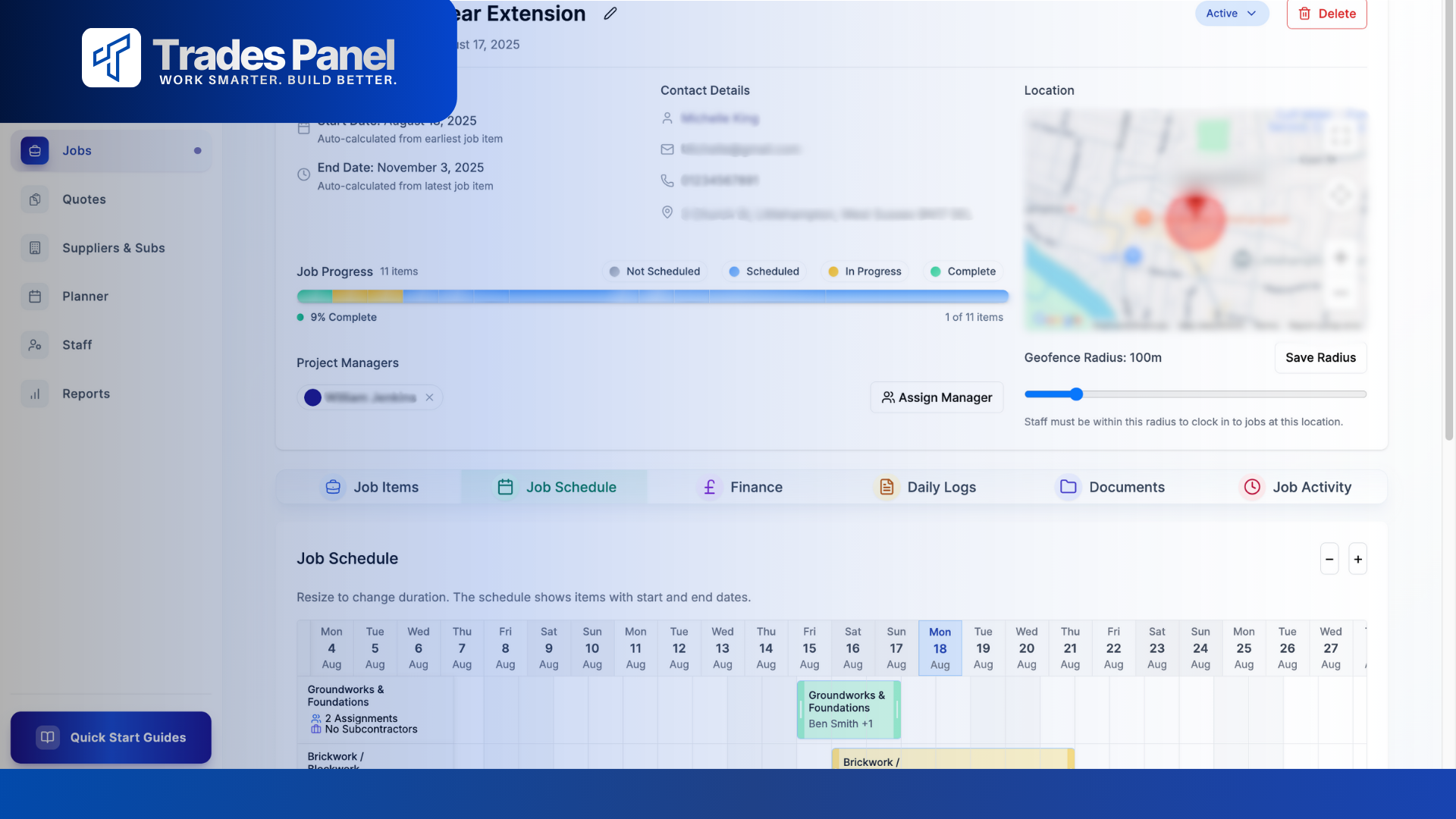
How Trades Panel Supports Systemisation in Construction
Trades Panel is designed to support systemisation across the core operational areas of a construction business.
Rather than adding complexity, it brings key workflows together in one place so information is easier to manage, share, and act on.
Key areas supported include:
Job tracking and scheduling
Jobs follow a consistent structure, making it easier to see progress, allocate work, and identify issues early.Time and cost visibility
Labour time and job costs are recorded as work happens, providing accurate data without the need for manual reconciliation.Invoicing connected to job data
Invoices can be generated directly from completed work and recorded time, reducing delays and errors.Business dashboards
Clear dashboards provide an overview of what is happening across jobs, teams, and finances at any given time.
By connecting these processes, Trades Panel helps reduce reliance on memory, spreadsheets, and disconnected tools. The result is a more structured, transparent way of running the business, without losing flexibility on site.
How Trades Panel Helps Systemise Construction Businesses
Trades Panel helps construction businesses systemise their operations by bringing job tracking, scheduling, time recording, invoicing, and reporting into one connected platform.
This allows contractors to replace manual processes and disconnected tools with a structured, easy‑to‑manage system.
Getting Started with Systemisation (Without Overhauling Everything)
Systemisation does not need to happen all at once.
For most construction businesses, progress comes from improving one area at a time rather than attempting a full overhaul.
1. Start with One Repeating Process
Begin with a process that causes regular friction. This might be job setup, time tracking, or invoicing.
If a task is repeated frequently or regularly causes confusion, it is a strong candidate for systemisation.
2. Make the Process Visible
Once a process is identified, document the steps involved.
Move those steps into a shared system so they are no longer dependent on memory or individual experience. Visibility is what allows consistency to take hold.
3. Build from There
After one process is running smoothly, apply the same approach to the next area of the business.
Systemisation works best when it is incremental. Each improvement reduces pressure and makes the next step easier.
Steady progress is far more effective than rapid change.
Building a Business That Doesn’t Rely on Constant Supervision
Systemisation is not about control. It is about clarity.
When processes are clear and information is visible, the business becomes easier to manage, easier to grow, and easier to step away from when needed. Decisions are made with better information. Teams work with greater confidence. Owners spend less time reacting and more time leading.
Over time, this shift moves a construction business from being reactive to becoming stable, sustainable, and resilient.
Ready to Bring More Structure to Your Business?
Many construction and trade businesses use systemised processes to improve visibility, reduce pressure, and operate more consistently.
If you are ready to take the first step, building simple systems is a practical place to start.